Prague, 5 November 2026 – Artificial intelligence is the number one investment priority in customer care for companies in the Czech Republic, Slovakia and the wider CEE region. 77% of companies plan to invest most in AI and automation in 2027, yet only 27% use it as a routine part of their daily work. These are the findings of the Daktela Customer Care Insights 2027 report, based on responses from 132 customer care leaders across six European countries.
“Customer care is changing at a pace that is hard to prepare for based on guesswork alone. Companies keep asking us the same questions: Are we getting our priorities right? Are we missing the AI train? And what is the competition investing in? Most of them answer these questions internally, with nothing to compare against. That’s why we decided to open the conversation with the people who actually run contact centres,” says Jiří Havlíček, CEO of Daktela.
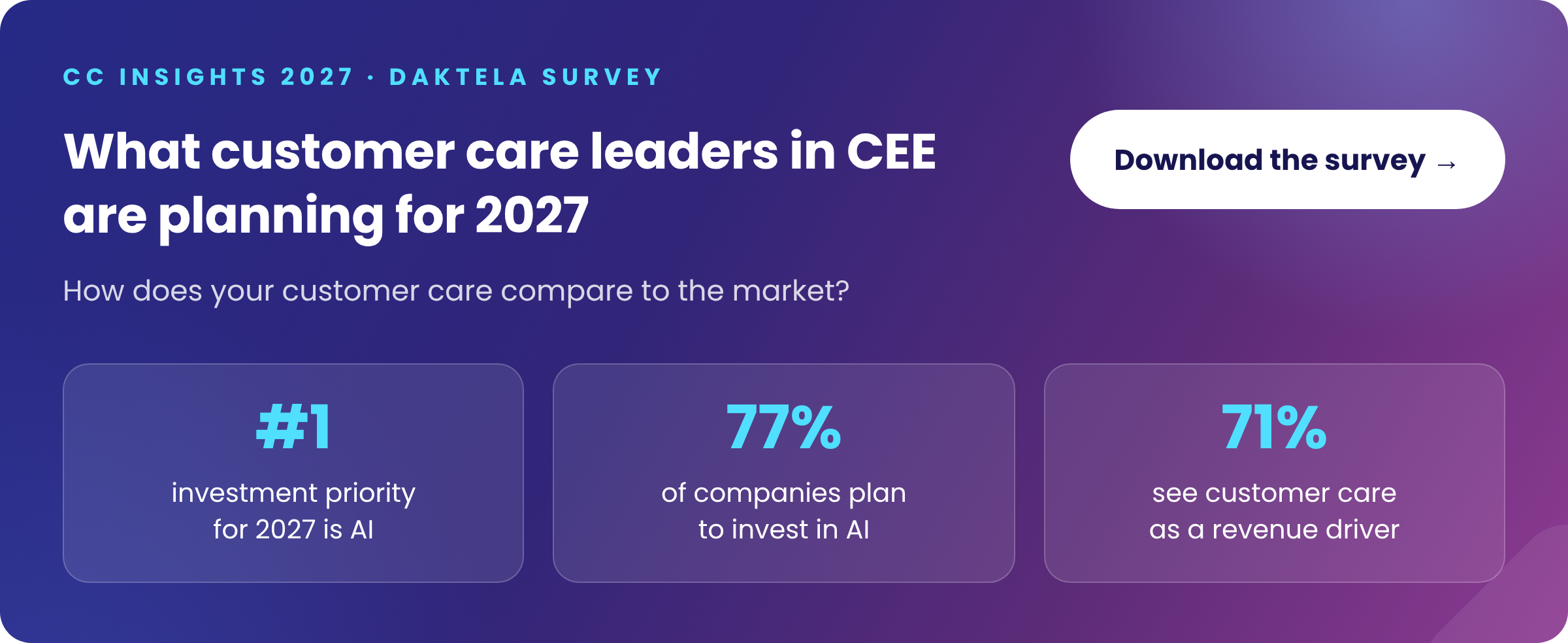
75% of companies named expanding AI and automation as one of their top three priorities for 2027. Only improving the customer experience was mentioned as often. 77% of companies plan to invest most in AI, more than in any other area of customer care.
Actual deployment lags behind these ambitions. Only 27% of companies use AI as a routine part of their daily work. Another 31% use it only marginally or to a limited extent, and 19% are running pilot projects or preparing implementation.
“The data is clear: AI is one of the top priorities for 2027. But reality is still far behind the ambition. The question is no longer whether to deploy AI. Successful companies should be clear about what AI should do and what people should do, and set up their processes, systems and measurement accordingly,” says Karel Vůjtek, COO of Daktela.
71% of respondents believe that by 2027, customer care will become a source of revenue (through upselling, retention and referrals).
“For me, customer care is clearly a revenue driver. Our investment in AI at Slevomat has paid off – we handle a growing volume of work with the same team and at higher quality,” says Tomáš Braverman, CEO of Slevomat Group.
Among companies that already use AI or plan to deploy it, 72% intend to introduce or expand AI assistance for agents (agent assist) by the end of 2027, meaning support that drafts suggested replies and looks up information. 65% plan AI agents and bots that communicate directly with customers, and 54% plan to automate back-office processes. Most companies are therefore introducing both at once: AI that helps people, and AI that talks to customers on its own.
“In a modern contact centre, AI drafts suggested replies, finds data across channels, or automatically creates and updates tickets. But the final decision stays with the agent, so any mistake is caught before the customer sees it. It is this human oversight that allows companies to safely hand most of the routine work over to AI and gradually build trust in its results,” says Mikuláš Starý, Head of Product at Daktela.
The biggest obstacle to adopting AI, cited by 42% of companies, is integration with existing systems. In second place, at 40%, are concerns about the accuracy and reliability of AI and whether customers will accept it. 21% mention data protection and regulation, and the same share cite a lack of internal skills or capacity.
78% of respondents see speed of response and resolution as the main source of competitive advantage in customer care. The human touch and empathy come second at 56%, while 49% of companies mention AI and automation in customer communication. The two are not mutually exclusive: AI provides instant answers to routine queries and frees agents to handle situations that call for empathy and human judgement.
The Customer Care Insights 2027 survey was completed by 132 respondents responsible for customer care: customer support managers, Heads of Customer Care, CTOs, COOs and business owners. Data was collected in August 2026 in the Czech Republic, Slovakia, Poland, Hungary, Romania and Serbia. Respondents represented companies of various sizes, from smaller businesses to large corporations, across a range of industries. Questions on specific areas of AI deployment were asked only of respondents who use AI or plan to deploy it (n = 113).
For more than 20 years, Daktela has been developing its own AI-driven platform for customer care. Its biggest advantage is that through a single platform with its own AI, companies can handle communication over the phone, email, web chat and social media, and automate it with smart AI bots. In the Czech Republic, Daktela also came to prominence as a co-author of the Smart Quarantine (Chytrá karanténa) project within the COVID19CZ initiative and of the 1221 information line.
Daktela is one of the largest SaaS companies in the Czech Republic, operating in seven markets and in many others through partners. The company currently has more than 170 employees. In 2021, Daktela received investment from the private equity fund Sandberg Capital, one of the most significant technology investors in the region. For more information, visit www.daktela.com and www.sandbergcapital.com.
Media contact:
Mgr. Kristýna Jurenová
Head of Marketing
kristyna.jurenova@daktela.com
+420 774 982 941


