Daktela’s Customer Care Insights 2027 report outlines the plans of 132 customer care leaders from the CEE region. Expanding AI adoption and improving the customer experience are each among the top priorities for 75% of the companies surveyed. AI is primarily intended to support agents and help teams handle more requests. Meanwhile, 63% of companies want to maintain their current team size. Alongside speed, a human touch and empathy remain important.

Where should we invest, how can we use AI, and how can we meet the growing demands on customer support? Many companies are grappling with these questions today, often without a way to compare their plans with those of others.
That is why, in August and September 2026, we surveyed 132 professionals who manage customer care firsthand. Support managers, technology directors and business owners across the CEE region shared their priorities, expectations and concerns for 2027.
The result is Customer Care Insights 2027. The report reveals strong interest in AI, but also shows that adopting the technology alone is not enough. Companies are looking for ways to respond faster, maintain service quality and give agents more time to work with customers.
Expanding AI and automation ranked among the top three priorities for 75% of the companies surveyed. The same proportion cited improving customer experience and satisfaction. Reducing costs and increasing efficiency followed at 66%.
The combination of these priorities is revealing. Companies want to use technology to reduce costs while also delivering better customer care. Their decisions will therefore depend on where automation can genuinely simplify work and help customers get answers faster.
Investment plans reflect this balance. AI and automation were identified as a key investment area by 77% of companies, more than any other area. Yet AI is currently a routine part of daily work for just 27% of respondents.
This raises an important question for the year ahead: how can companies move AI beyond pilot projects and limited use to make it a tool that supports their teams every day?
When you think of AI in customer care, a chatbot or voice assistant probably comes to mind. But the report shows that supporting agents themselves is also attracting considerable attention.
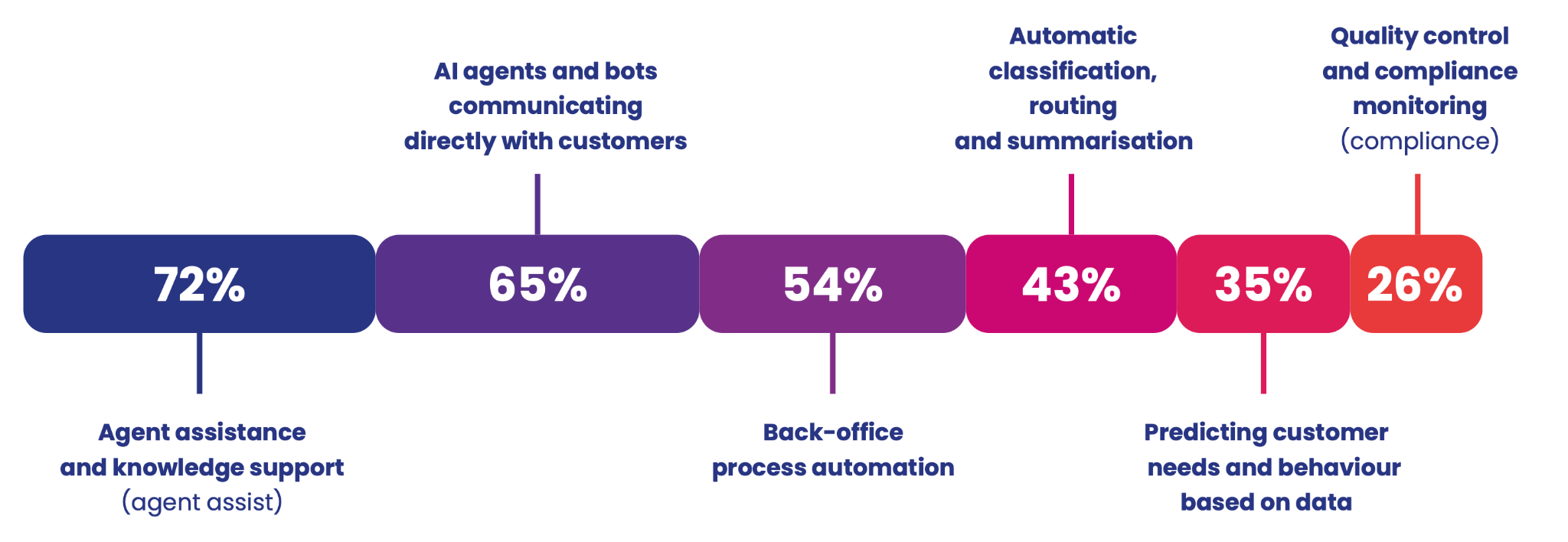
Among respondents who use AI or plan to adopt it, 72% want to expand agent assistance and knowledge support. AI agents and bots that communicate directly with customers were cited by 65%. This part of the survey included 113 respondents, who could select multiple areas.
The two approaches naturally complement each other. While an AI chatbot can handle recurring customer queries, Daktela AI Copilot helps agents find information, summarise conversations and draft responses.
Agents can have a lengthy ticket summarised or an email drafted directly in Daktela. AI can therefore also make a difference in tasks that customers do not see. Less time spent searching for information and handling administration means more time to resolve the request itself.
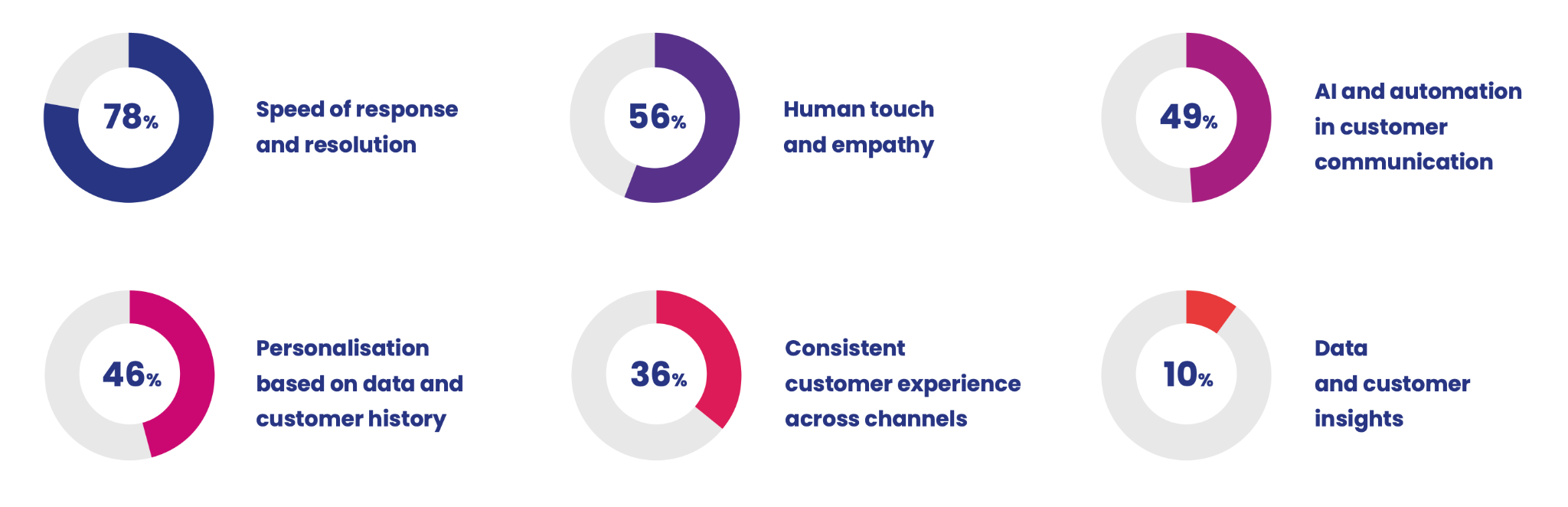
What will set customer care apart from the competition? For 78% of respondents, it is response and resolution speed.A human touch and empathy remain the second most frequently cited source of competitive advantage, at 56%.
Automation and a human touch can work well together. For a routine question, customers appreciate an immediate answer. A more complex or sensitive situation, however, calls for a person who can understand the context and suggest an appropriate solution.
To ensure a smooth transition between these parts of customer care, agents need access to previous conversations. Connected channels and a shared customer history in the Daktela contact centre help ensure that agents do not have to start from scratch after a handover.
Interest in AI is strong, but its adoption faces practical obstacles. For 42% of the companies surveyed, integrating AI with existing systems is one of the main barriers. A further 40% cite concerns about its accuracy, reliability and acceptance by customers.
This is important for anyone planning to implement AI. The quality of automation also depends on the information a tool can access and how up to date that information is. Without it, even a quick response may not help the customer.
It therefore makes sense to start with a specific use case, check data availability and establish a handover process to a human agent. A gradual rollout allows companies to monitor results and expand automation based on practical experience. We explore this approach in more detail in our article on customer support automation.
Most of the companies surveyed are not planning to do so. 63% want to maintain their current headcount and use AI to handle a growing volume of requests. Reducing employee numbers through automation is planned by 15%.
Most companies therefore expect technology to increase the capacity of their existing teams. However, agents’ work will also change. As AI takes over some straightforward queries, people will more often handle unusual cases and situations that require experience or empathy.
Preparing for 2027 therefore also means developing people. Beyond learning to use new tools, agents will need the knowledge, support and authority to resolve more demanding requests.
The report also explores how leaders view the role of support within the wider business.
71% agree that customer care will become a source of revenue by 2027, for example through customer retention, upselling and referrals.
Customer care influences whether customers complete a purchase or return to a company. It also provides insights into their needs, the obstacles they face and the reasons for their dissatisfaction. Companies that act on these insights gain a basis for improving services and making better business decisions.
This makes it all the more important to track the actual outcomes of changes. Alongside response speed, companies should monitor satisfaction, repeat contacts and whether requests were resolved. These measures help establish whether an investment benefits both customers and the business.
Customer Care Insights 2027 shows that companies have a fairly clear sense of their priorities. They want to use AI, deliver faster service and maintain a human touch. The biggest challenge will be translating these plans into the way their teams work every day.
At Daktela, we bring customer communications and AI tools together in one platform. If you are considering similar changes, book a demo and we can explore where they could help your team.
Want a broader view of priorities, investments and expectations for the coming year? Download the full Customer Care Insights 2027 report for free and get 18 pages packed with data and insights from 132 professionals across the CEE region to help you compare your plans and decide where to invest in 2027.